PIONEERS: Alexander Anyanjo Ejisimekwu Ohiaeri
Pioneers Section is dedicated to the first generation of Umu Ohiaeri who stepped into new worlds of education, work and migration.They were the first to carry the Ohiaeri name to the outside world, laying the foundation upon which later generations now stand.
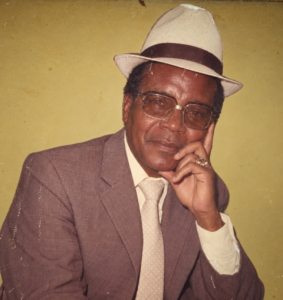
Dr Alexander Anyanjo Ejisimekwu Ohiaeri
Alexander Ejisimekwu Ohiaeri was born on December 12, 1925 to Ohiaeri Ewuzie and Janet Ukwudie Ohiaeri.
He enrolled in CMS Grammar School, Nkwerre in 1935, Dennis Memorial Grammar School (DMGS) Onitsha in 1943, and School of Forestry, Ibadan, in 1947.
He served as a clerk in the Ministry of Justice, Lagos, from 1948 to 1950.
On November 18, 1949, British colonial police shot striking coal miners at the Iva Valley Mine in Enugu, killing 21 and injuring 59.
The German Democratic Republic (East Germany) offered university scholarships to the children of the deceased miners. Only one of the miners’ children was old enough to attend university, so East Germany, through the Nigerian Trade Union Congress (TUC), made the scholarships available to selected Nigerian students.
Alexander Ejisimekwu was chosen.
In 1951, he became one of the first eleven Africans to be educated at a university in East Germany. In 1958, he obtained B.Sc, M.B and M.D degrees from Karl Marx University, Leipzig (now Leipzig University), the second-oldest university in Germany.
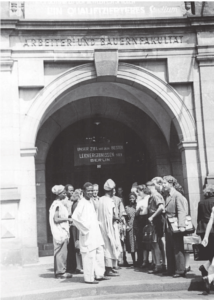
Alexander Ejisimekwu Ohiaeri smiling at the camera as a first-year student of Karl Marx University, Leipzing, July,1951
Past students of Leipzig University include Angela Merkel, the former Chancellor of Germany; Gottfried Wilhelm von Leibniz, co-inventor of calculus; Johann Wolfgang von Goethe, the influential German writer; and Friedrich Nietzsche, the German philosopher.
During his time at Leipzig University, Alexander adopted Anyanjo as his first name after a lecturer asked him why he had a Western name.
On his return from East Germany, Alexander was appointed Medical Officer, Ministry of Health, Eastern Nigeria. In 1963, he was appointed the resident Medical Officer, University of Nigeria, Nsukka. Three years later, he relocated to Aba and established Ohiaeri Memorial Hospital at 65B Ngwa Road.
At the end of the Nigerian civil war in 1970, he incorporated a multi-sector company, Ohiaeri Foundation, and expanded from the medical field to large-scale farming, manufacturing of tissue paper, newspaper publishing, restaurant business, art collection and in 1972, the establishment of Ohiaeri Museum, Nigeria’s first private museum.
He wrote the medical books High Blood Pressure (1962), Sterility in Men and Women (1963), Problems of Appendicitis (1964), Venereal Diseases (1965).
He wrote the novels Nwaulari: A Human Tragedy (1984), and Behind the Iron Curtain (1985). Nwaulari was required reading for Junior Secondary School literature students in the 1990s and Behind the Iron Curtain was used as reference material by Sara Pugach, California State University professor and author of African Students in East Germany, 1949-1975.
He also wrote an unpublished novel, Last Plane From Sao Tome (previously titled Operation Teutonic Sword), based on his experiences as a Biafran ambassador during the civil war.
Alexander was not just a medical doctor; he was also a research scientist. In 1962, he started studying the effectiveness of Igbo traditional medicine. He published his findings in a scientific paper titled A Study of the Folk Medicine of Nigeria (Eine Untersuchung der Volksmedizin Nigerias) in the German medical journal Zeitschrift für ärztliche Fortbildung.
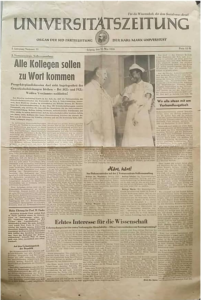
Dr Alexander Ejisimekwu Ohiaeri on the front page of the Karl Marx University newspaper
By 1965, he had discovered a monovalent anti-snake bite serum,which he called Nsukka Remedy.
The serum was effective against bites from the carpet viper (Echis ocellatus). He published his discovery in the Nigerian Medical Journal and took his research to the University of Jena, Germany, where the active ingredient of the serum was isolated. The outbreak of the Nigerian civil war prevented him from patenting the serum and licensing it to pharmaceutical companies for mass production
Like his elder brother Nathaniel, Alexander didn’t forget his cultural roots.
He was a member of Nze na Ozo society, and was conferred with multiple chieftaincy titles, including Okpukpuchereobi (literal meaning: Rib Cage, symbolic meaning: Defender of the Realm) of Abba, Omemma of Ugwunagbo, Dibia Di Oha Mma of Eziukwu Aba, Ezeahurukwe of Isu and Duruisinka of Imo State.
He served as President, Akanu Ibiam National Ambulance, Chairman of the Imo State Medical Association, Chairman of Aba Sports Council and Chairman of the Imo State Welfare Council.
He was a member, Aba Urban Schools Board, a member of Imo State University Council, a member of the National Task Force on Snake Bite, a member of Nigeria World Peace Council and part of the national delegation to the 1973 World Congress of Peace Forces in Moscow.
He was a Fellow of the Nigerian Medical College of Physicians (FMCP), a Fellow of the West African College of Physicians (FWACP), a Fellow of the International College of Angiology (FICA), and a recipient of the Albert Einstein Bronze Medal for Peace, awarded by the Albert Einstein International Academy Foundation, Malta.
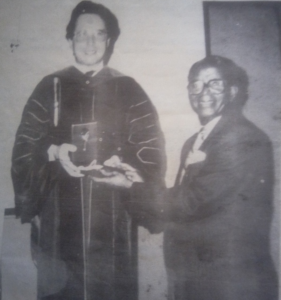
Dr Alexander Ejisimekwu Ohiaeri receiving the Albert Einstein Bronze Medal for Peace from Prof Dr Marcel Dingli-Attard in Malta, 1988.
He accelerated the development of his hometown, Abba, Imo State, by serving as President of Abba Development Union (ADU) from 1980 to 1986.
As President of ADU, he drafted Abba’s first written constitution, introduced the Abba Nwauruogu symbol in honour of Captain Uburu, the founding father of Abba, and facilitated the installation and coronation of Eze Madukwem Unaka, the traditional ruler of Abba.
At the end of his tenure, he was made the National Patron of ADU, the Deputy Chairman of Abba Council of Chiefs and the Chairman of Umudurunna Abba community.
He was a foremost philanthropist who assisted many relatives and non-relatives. His favorite quote, displayed in the reception area of Ohiaeri Memorial Hospital and often attributed to Mahatma Gandhi, was in fact written by Étienne de Grellet, a 19th-century French missionary:
I shall pass through this world but once. Any good, therefore, that I can do or any kindness I can show to any human being, let me do it now. Let me not defer nor neglect it, for I shall not pass this way again.
Alexander Anyanjo Ejisimekwu Ohiaeri was a Renaissance man, whose interests and activities spanned the sciences, the arts and the humanities.
He died on February 1,1996, and was survived by his wife, Chief Mrs Veronica Olunwa Ohiaeri and seven children.